
Quick answer: Guilt when you relax isn't a character flaw - it's a trained alarm. Somewhere along the way your brain learned that busy means safe and worthwhile, so the moment you stop, it fires guilt to get you moving again. Because that rule was learned, it can be untrained: put rest in the diary, start with small doses, give rest a proper job, close your working day out loud, and let the guilt pass without obeying it.
It's Saturday afternoon. Nothing is due, no one needs you - and you've lasted about ten minutes on the sofa. Now you're up: unloading the dishwasher, glancing at your work phone, mentally drafting Monday. If sitting still makes you feel restless, itchy, or quietly ashamed, you're not lazy and you're not broken. Your nervous system has simply learned to treat rest as a rule-break - and it enforces the rule with guilt.
It's remarkably common, and the UK is particularly good at it. When NatWest surveyed British workers in 2024, 45% weren't taking their full annual leave - and those who did go away worked an average of 2.5 days of a 7-day break. Nearly half of us can't fully stop even when we've booked the time to.
One client, a project manager, described her "days off" perfectly: by 10am she'd have cleaned the flat, answered a few emails she "just wanted off her plate", and started a life-admin list. Sitting down in daylight, she said, felt like being watched. Nobody was watching. The supervisor was in her own head.
What's actually happening
For most professionals this rule was installed early and reinforced often: gold stars for effort at school, praise for being "so reliable" at work, promotions for going the extra mile. Over years, your brain quietly welds two things together - being productive and being worth something. Once that weld sets, stillness isn't neutral. It's evidence you're not currently earning your place, and guilt is the alarm that says so.
There's a stress layer too. A demanding week keeps your body in "go" mode, primed to scan for the next task. Occupational psychologists call the antidote psychological detachment - genuinely switching off from work in your head, not just in your diary - and it's one of the most consistent predictors of wellbeing and next-day energy in the research. The catch is what researchers call the recovery paradox: the more stressed you are, the harder detaching becomes. The weeks you most need rest are precisely the weeks your brain is least willing to allow it.
Why relaxing can actually feel worse
Here's the strange part: for a wound-up nervous system, relaxing isn't just difficult - it can be genuinely uncomfortable. Researchers at Penn State found that some anxious people experience "relaxation-induced anxiety" - staying tense on purpose because the drop from calm back to stress feels worse than never calming down at all. If relaxing makes you feel more on edge, that's not you failing at rest. That's your brain avoiding the gear change.
Your body can join in too. Dutch researchers studying "leisure sickness" found around 3% of people reliably come down with headaches, fatigue or colds the moment the weekend or a holiday starts - and the profile fits a pattern: high workload, high sense of responsibility, and difficulty adapting to not working. The system holds itself together while you're needed, then protests the moment you're not.
So the guilt, the restlessness, even the holiday cold - they're all the same message from the same place: a nervous system that no longer trusts "off".

How to rest without the guilt
You don't beat this by arguing with the guilt or by forcing yourself through joyless "self-care". You retrain the rule underneath it - gently, and in doses your nervous system will accept.
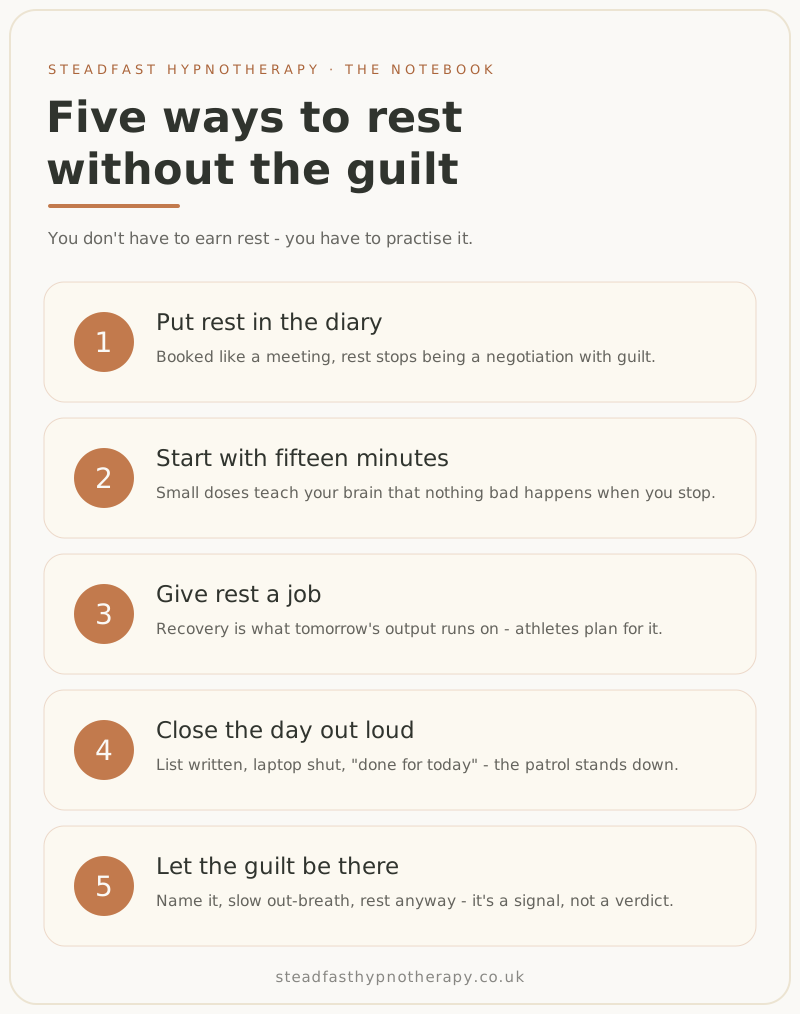
- Put rest in the diary. Guilt wins its battles one small negotiation at a time - "should I be doing something?" asked fifty times an afternoon. So make the decision once, in advance: rest goes in the calendar like a meeting, with a start and an end. You're not skiving; you're keeping an appointment. Professionals tend to honour appointments - use that wiring in your favour.
- Start with fifteen minutes. If an idle Sunday feels impossible, don't start with an idle Sunday. Start with fifteen protected minutes - tea, window, nothing else - and let the alarm fire without acting on it. Small, repeated doses teach your brain the one thing arguments can't: nothing bad happens when you stop. Then the dose can grow.
- Give rest a job. If your brain refuses to value rest for its own sake, give it the business case: recovery is what output runs on. Athletes plan rest days because that's when the adaptation happens - and the detachment research shows properly switched-off evenings predict better mood, energy and performance the next day. You're not stopping the work. You're maintaining the person who does it.
- Close the day out loud. A brain will patrol every loop it thinks is still open. So close them: write tomorrow's list, shut the laptop, and mark the ending - "done for today" - the same way each time. It sounds small; done consistently it becomes the cue that stands the patrol down. (If evenings are where this bites hardest, I've written more on why you can't switch off after work.)
- Let the guilt be there. The goal isn't to feel zero guilt before you rest - that's the old rule demanding you earn it. Name it ("there's the guilt"), take a few slow breaths with a longer out-breath - slow-paced breathing raises "rest and recover" activity in the nervous system - and carry on resting anyway. Guilt that gets acknowledged but not obeyed loses its authority surprisingly fast.
Rest isn't the reward you get for finishing everything. It's the fuel for everything that isn't finished yet.
When it's more than a habit
A restless day off is one thing. But if the guilt follows you everywhere - if resting triggers feelings of worthlessness, or your mood has been low and flat for weeks - please take that seriously and talk to your GP. And if Sunday evenings are the moment the dread peaks, that has its own pattern; I've written about Sunday night anxiety separately.
Can hypnotherapy help me actually relax?
The frustrating thing about rest-guilt is that you can't reason your way out of it - you likely already know, intellectually, that you're allowed to relax. The rule doesn't live in the logical part of the mind. It fires automatically, from the subconscious, stress-trained side - which is exactly where solution-focused hypnotherapy works. In sessions we calm the threat-mode state that keeps you patrolling, and mentally rehearse the off-duty version of you until it stops feeling like trespassing. And the trance portion of each session is itself deep, guided rest - so your nervous system isn't told that stillness is safe, it gets to experience it, week after week.
The project manager is a good example. We never debated whether she deserved a day off. We worked on how her week ended, settled her nervous system, and rehearsed - in detail - a Saturday with nowhere to be. A few sessions in, she took one. The guilt showed up around mid-morning, said its piece, and left. As she put it: "It turns out the flat survives me sitting down."
If the ten-minutes-on-the-sofa scene felt familiar, that's a good sign this is exactly the kind of pattern this work helps with.