
Quick answer: Going blank in an interview isn't poor preparation or lack of ability - it's biology. Under evaluation stress, the brain region that assembles your answers temporarily goes offline, so you lose access to what you know, not the knowledge itself. It's trainable: prepare stories rather than scripts, rename the nerves as readiness, slow your out-breath, buy thinking time out loud, and rehearse the calm version of you in advance.
"So - tell me about yourself." You've answered that question a hundred times in your head. And now: nothing. The silence stretches, your heart is somewhere near your ears, and the person you were in the car park - articulate, experienced, prepared - has apparently left the building. If this is you, you're in enormous company: in one large survey, 93% of people said they'd felt anxious before a job interview, and UK research has found interviews beat even public speaking as the situation Brits fear most.
One client - a marketing manager with fifteen years of experience - came to me after an interview where she'd blanked on a question about a campaign she had run. "I could see the slide in my head," she said, "I just couldn't reach it." That's the experience in one sentence: the knowledge is there. The door to it is shut.
What's actually happening
The part of your brain that holds a question in mind, searches your memory and assembles a coherent answer is the prefrontal cortex - think of it as the desk where your answers get put together. It's brilliant, and it's fragile. Neuroscience research shows that even mild uncontrollable stress floods the prefrontal cortex with stress chemicals and rapidly impairs it, handing control to the faster, more primitive threat system. Your brain, deciding this is an emergency, clears the desk.
That's why the blank feels so total - and why it's so unfair. The threat system is superb at getting you away from danger and useless at describing a campaign you ran in 2024. And here's the proof it was never about ability: the answers come back on the drive home, the moment the pressure lifts and the desk reopens.
Interviews hit this system unusually hard because they stack the exact ingredients the threat system watches for: being evaluated by strangers, high stakes, a one-shot performance, and a formal setting that strips away the normal rhythm of conversation. Your brain isn't malfunctioning. It's protecting you from what it reads - wrongly - as an ambush.

How to stay clear-headed in interviews
You can't talk your threat system out of firing on the day - but you can train it beforehand, lighten the load on your memory, and give yourself recovery moves for the moments that wobble.
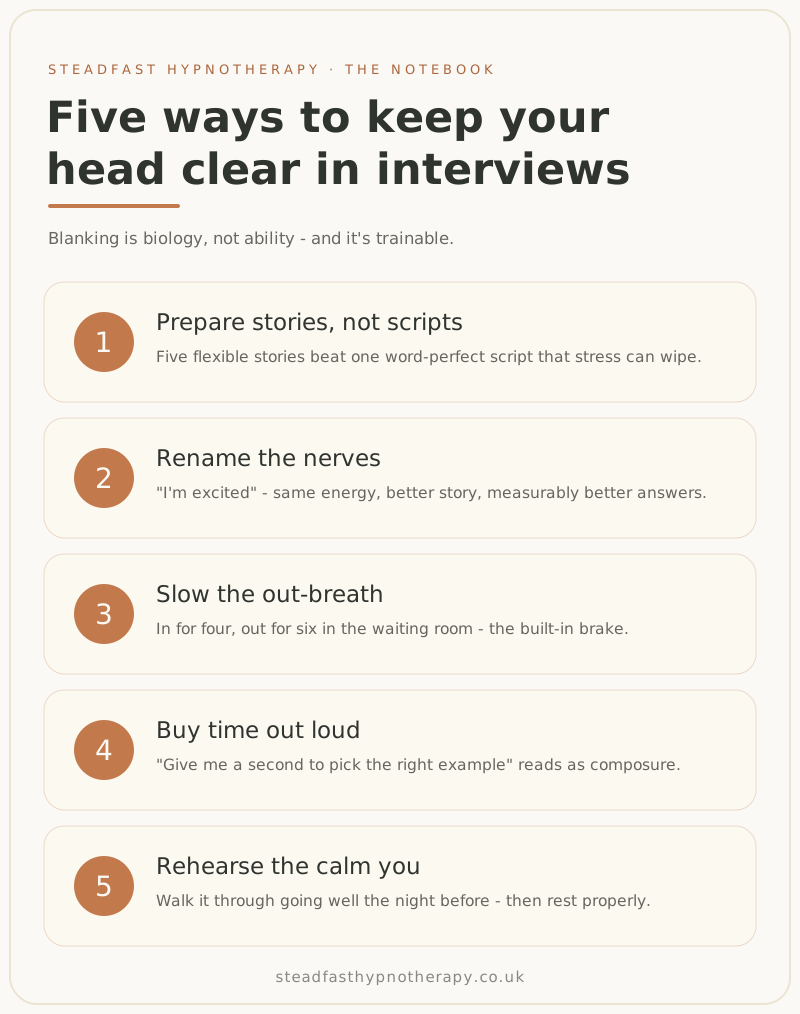
- Prepare stories, not scripts. A memorised script demands word-perfect recall - the exact ability stress takes first. Instead, prepare five flexible stories from your career (a win, a challenge, a conflict, a failure you learned from, a change you led). Stories are stored deeper than scripts, survive pressure far better, and between them cover most questions an interviewer can ask.
- Rename the nerves. Racing heart, quick breath - your body calls it readiness; your mind labels it fear. In a well-known Harvard study, people who relabelled pre-performance anxiety as excitement - literally saying "I am excited" - performed measurably better than those who tried to calm down. Same energy, better story: this is my system showing up for something that matters.
- Slow your out-breath in the waiting room. The fastest lever on the threat system is breath: in for about four, out for about six, a few quiet rounds. Slow-paced breathing with a longer exhale raises "rest and recover" activity in the nervous system - it's the built-in brake, and nobody in the room can tell you're using it.
- If you blank, buy time out loud. Have your recovery line ready: "That's a good question - let me take a second to pick the right example." Said calmly, it reads as composure, not weakness. Take a sip of water, breathe out, ask for the question again if you need it. Interviewers see blanks constantly; what they remember is the recovery.
- Rehearse the calm version of you. The night before, run the film once: arriving early, shaking hands, sitting down steady, answering in your own voice. Vivid mental rehearsal gives your brain a memory of the interview going well - so the real thing feels like the second time, not the first. Then close the laptop and give yourself a properly restful evening; a rested brain retrieves, an exhausted one blanks.
You don't lose what you know in an interview. You lose access to it - and calm is what hands the key back.
When it's more than interview nerves
Feeling wired before an interview is normal and workable. But if the fear is stopping you applying at all, or the same dread follows you into meetings, presentations and everyday conversations at work, that's worth proper attention - talk to your GP, and know that this broader pattern is very treatable too.
Can hypnotherapy help with interview nerves?
Here's the part most interview advice misses: the nerves don't start in the interview. They start days earlier - lying awake, imagining hard questions, feeling your stomach drop at the calendar reminder. That's your brain rehearsing the interview going badly, over and over, which is precisely why the real thing feels so loaded by the time you arrive. Solution-focused hypnotherapy works on both ends of that: we calm the baseline state so the anticipation loop quietens, and then - in deep relaxation - rehearse the interview going well, repeatedly and in detail. Mental rehearsal is the brain's native training method; hypnotherapy simply runs it in the calmest possible state, so that composed, clear-headed version of you becomes the familiar one.
The marketing manager came back after her next interview - a bigger role, tougher panel - with a different report. She'd paused twice, used her line, and got both answers out. "The questions finally sounded like questions," she said, "not tests." She got the job - but the bit she was proudest of was the pause.
If the silent-room moment felt familiar, that's a good sign this is exactly the kind of pattern this work helps with.