
Quick answer: Staying quiet in meetings isn't a lack of ideas - it's a threat response. Your brain reads the room's attention as danger, floods your system, and suddenly your heart is loud, your throat is tight and the moment has passed. It's also running on a distortion: research shows people massively overestimate how closely others are watching them. The way out is practical: speak early, prepare one contribution, shrink the spotlight, breathe out before you speak, and collect evidence afterwards.
You had the point. You'd rehearsed it twice in your head. Then your heart started thudding, the discussion moved on - and ten minutes later a colleague said your idea and got the nod for it. If that scene stings because it's familiar, you're far from alone: in one recent survey, 6 in 10 employees said they hesitate to speak up at work. Most of them don't lack opinions. They lack a nervous system that will let the opinions out.
One client, a senior analyst, put it this way: in one-to-ones he was sharp, funny, full of ideas. In anything bigger than four people, he went quiet. His notes app was full of perfectly-worded points that had never been said out loud. "I don't freeze because I have nothing," he told me. "I freeze because it suddenly feels like everything depends on saying it perfectly."
What's actually happening
Your brain runs social risk through the same threat system it uses for physical danger. Being wrong in front of the group, sounding nervous, having twelve pairs of eyes turn to you at once - to an over-trained alarm system, that's an ambush. So it does what it's built to do: adrenaline up, heart rate up, breath high in the chest, and your thinking narrowed to escape rather than eloquence. It's the same mechanism that blanks minds in interviews - just spread across every Tuesday of your working life.
Worse, the fear is anticipatory. The dread doesn't start when you speak; it starts when the meeting lands in your calendar, builds through every agenda item, and peaks as your moment approaches - which is why the longer you wait to contribute, the harder contributing gets.
And here's the distortion holding the whole thing up: you are not nearly as visible as you feel. In a classic Cornell study on what's now called the spotlight effect, people in group discussions consistently overestimated how much their comments - good and bad - stood out to everyone else. You experience your shaky sentence in high definition. The room, busy rehearsing its own lines, barely registers it.

How to speak up in meetings
None of this asks you to become the loudest person in the room. The aim is smaller and better: a nervous system that lets you say the thing you already had.
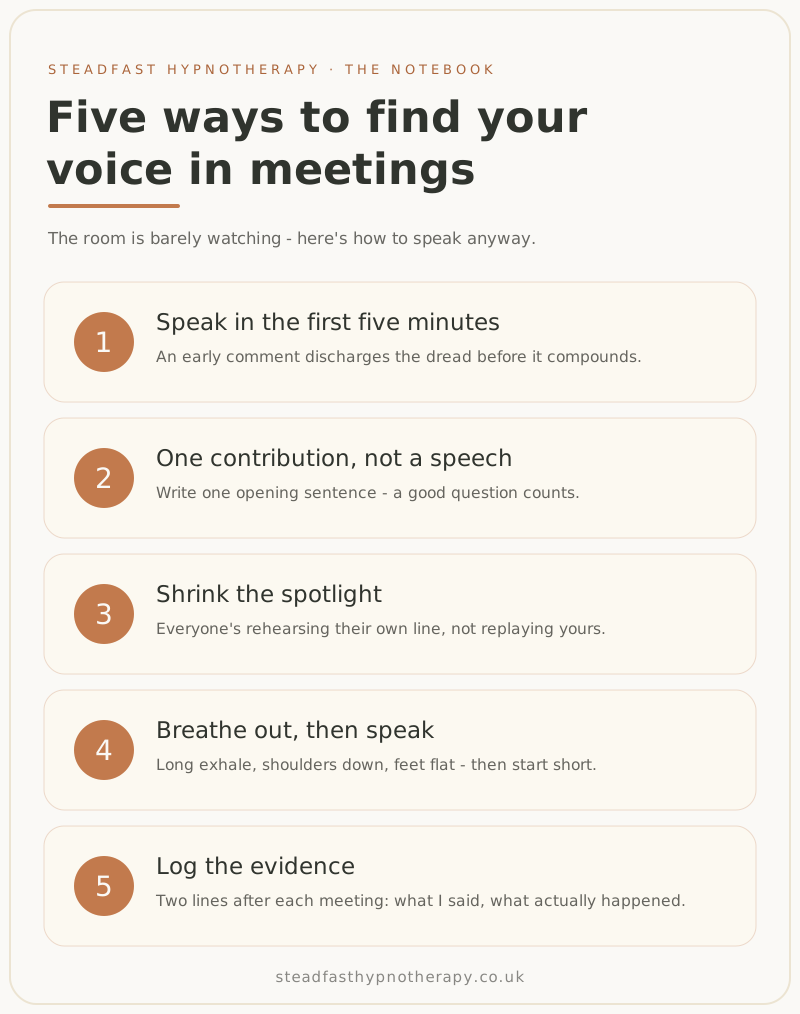
- Speak in the first five minutes. Anticipation is the fuel, so cut it off early. Say something - anything low-stakes - near the start: a greeting, a clarifying question, agreement with the last point. Once your voice has been in the room, you've told your threat system the ambush isn't coming, and every later contribution costs less.
- Prepare one contribution, not a speech. Before the meeting, write a single opening sentence - one observation or one question. Questions are underrated: they count as speaking up, they're hard to get "wrong", and they often move the discussion more than statements do. One prepared sentence beats ten perfect points that stay in the notes app.
- Shrink the spotlight. When the fear says everyone will notice, use the research: they measurably don't. Everyone in that room is starring in their own meeting - worrying about their own point, their own boss, their own lunch. Your wobble is a background detail in their film. Let that be liberating rather than insulting.
- Breathe out, then speak. A shaky voice is held breath meeting a fast heart. Just before you come in, take a slow breath with a longer out-breath - slow exhaling raises "rest and recover" activity in the nervous system - drop your shoulders, put both feet flat, and start with a short sentence. Momentum does the rest.
- Log the evidence. Your alarm system predicts disaster every time; it stays loud because nobody checks its accuracy. So check it. After each meeting where you spoke, write two lines: what I said, what actually happened. A few weeks of "nothing bad - two people nodded" is exactly the data your brain needs to stand down.
The room isn't waiting for you to fail. The room is barely watching - everyone in it is rehearsing their own line.
When it's more than meeting nerves
If the fear isn't contained to meetings - if being observed, eating in front of others, or everyday conversations bring the same dread - it may be part of a broader pattern of social anxiety, which is common and very treatable. Talking to your GP is a good first step, and none of it means anything is wrong with who you are.
Can hypnotherapy help with meeting anxiety?
The reason meeting nerves survive years of "just be more confident" advice is that they don't run on logic - they run on an automatic threat response and a well-practised anticipation loop. By the time the meeting starts, your brain has already rehearsed going red, stumbling, being judged. Solution-focused hypnotherapy works exactly there: we calm the baseline state so the loop has less charge, and then - in deep relaxation - rehearse the other version, in detail: settling into the chair, breathing out, saying your sentence in a steady voice. Rehearsed calmly and often enough, that version becomes the familiar one - and your voice steadies because your system has.
The analyst got there in stages. First a question in a small stand-up. Then a point - his own point, out loud - in the weekly team meeting. A few weeks later he asked a question in the all-hands, the setting he'd avoided for years. His review afterwards: "Nobody gasped. Two people nodded. That was it - that was the whole disaster."
If the notes-app-full-of-unsaid-points felt familiar, that's a good sign this is exactly the kind of pattern this work helps with.