
Quick answer: Vaping doesn't relieve your stress: it creates the stress it then relieves. Nicotine leaves your system within a couple of hours, and the restless, edgy feeling that follows is withdrawal, not your job. The next vape settles it, and your brain files that as "this is how I cope". Break the loop by naming what the urge actually is, riding it out, giving the break back without the vape, cutting the strongest cues, and calming the underlying stress so there's less to reach for.
Three-thirty. You're outside again, standing near the bins, not really enjoying it. You told yourself it was for the fresh air, or a break from the screen. But you didn't come out because you wanted to. You came out because something under your ribs got restless about twenty minutes ago and hasn't settled since. If that's familiar, you're not weak-willed and you're not "addicted to stress". You're in a loop that's designed to be hard to spot from the inside.
You're also in enormous company. Around 5.5 million adults in Great Britain now vape - roughly one in ten of us.
One client, an operations manager, put it neatly: he'd quit cigarettes years earlier and was proud of it. But he was vaping more than he'd ever smoked. "It's not even a treat any more," he said. "It's just something I do between problems."
What's actually happening
Here's the trap, and it's a good one. Nicotine has a short life in the body - a couple of hours and it's largely gone. As the level drops, you get restless, irritable, slightly unable to concentrate. That feeling is withdrawal. But it arrives without a label on it, so your mind looks around for a cause and lands on the nearest one: the deadline, the inbox, the meeting at four.
Then you vape, and it settles. Which your brain reads as: the vape fixed my stress.
It didn't. It fixed the withdrawal it caused. Psychologist Andrew Parrott made exactly this point about smokers in a well-known paper in American Psychologist: smokers feel normal while smoking and worse in between, and the apparent relaxing effect is mostly just the reversal of tension that built up since the last one. Nicotine isn't a stress solution. It's a stress generator with a very fast off-switch.
Vaping makes this worse than cigarettes in one specific way: a cigarette ends and a vape doesn't. There's no natural full stop, so you top up all day: which means more withdrawal dips, more rescues, and far more repetitions teaching your brain that nicotine is how you handle pressure.
The bit nobody mentions: it's making the anxiety worse
If you use your vape to take the edge off, this is the part worth sitting with. Every cycle of dip-and-rescue is a small stress event, and you're running maybe fifteen of them a day. Over time, that shows: people who use nicotine tend to report higher baseline anxiety, not lower.
The encouraging half of that same finding is what happens afterwards. In work by Truth Initiative, 90% of people who quit vaping said they felt less stressed, anxious or depressed - not more. The thing you're using to cope is a meaningful part of what you're coping with.

"But I actually enjoy it"
Good: say that out loud, because it's the most honest sentence in this whole thing, and pretending otherwise is why a lot of quit attempts fail.
You're not confused. You genuinely do get something from it: a break, a moment alone, a full stop between tasks, something to do with your hands. Those are real needs, and they don't disappear because the nicotine does. Most people quit by removing the vape and keeping the needs - then wonder why they feel bereaved.
Wanting to stop and not wanting to stop at the same time isn't a failure of resolve. It's ambivalence, and it's the normal state before change - not a sign you're not ready. The way through isn't to argue yourself out of the enjoyment. It's to work out what the vape is genuinely giving you, and get that another way.
How to stop vaping when stress is the trigger
None of this is willpower theatre. Each one works on a different part of the loop.
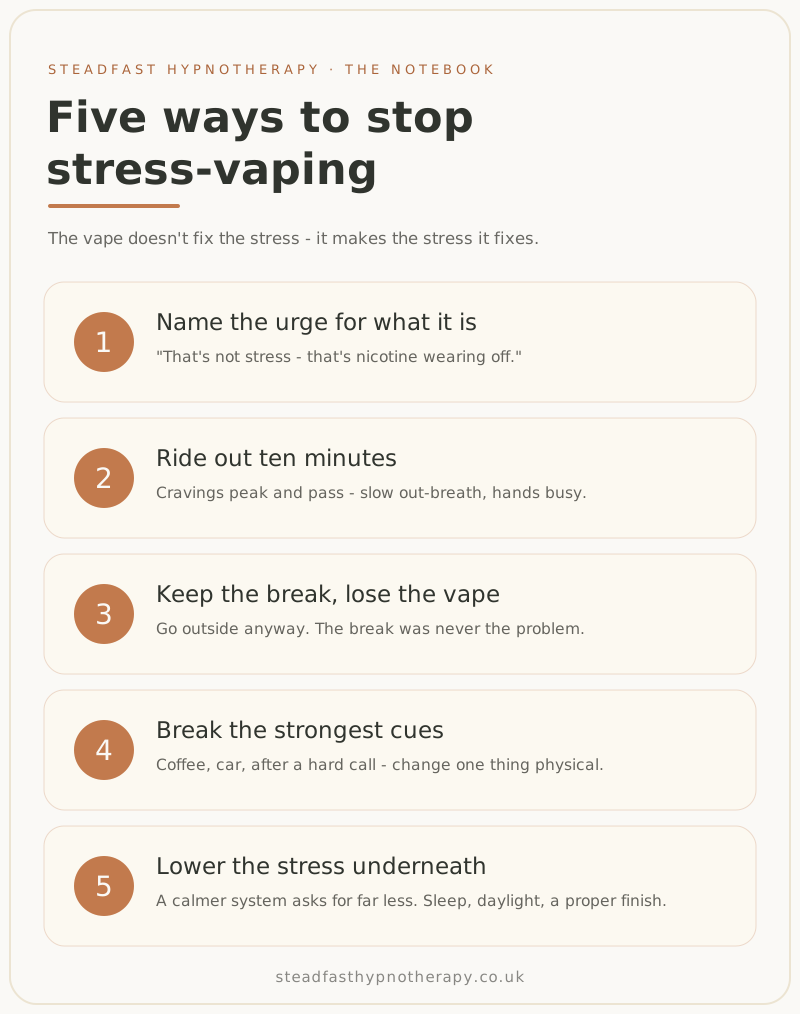
- Name the urge for what it is. Next time the restlessness arrives, try: "That's not stress. That's nicotine wearing off." It sounds almost too simple, but the loop runs on a mislabel, and correcting it takes most of the authority out of the urge. You stop treating the vape as a solution to your job.
- Ride out ten minutes. Cravings feel permanent and behave like waves: they build, peak and pass, usually inside ten minutes. Set a timer and do something with your hands. A few slow breaths with a longer out-breath helps: slow-paced breathing raises "rest and recover" activity in the nervous system, which is the thing you were actually after.
- Keep the break, lose the vape. This is the one people skip. The break was never the problem - go outside anyway, at the same times. Walk the block, get the air, stand somewhere else for four minutes. Take the vape out of the ritual and keep everything else, and you're not giving something up, you're just doing it without the nicotine.
- Break the strongest cues. Habits attach to context: the coffee, the car, the first thing after a hard call. Pick your two or three biggest triggers and change something physical: different pocket, different route, tea instead of coffee for a fortnight, vape left in a drawer rather than on the desk. You're not relying on resolve, you're removing the prompt.
- Lower the stress underneath. If your baseline is high, urges are louder and every technique is harder. Protect your sleep, get the daylight, and give the working day a proper ending. It's the same principle as switching off after work - a calmer system asks for far less.
You're not vaping because your job is stressful. You're vaping because you last vaped two hours ago.
When it's more than a habit
Vaping to take the edge off a hard week is one thing. But if anxiety or low mood has been there for a while regardless of nicotine, it's worth speaking to your GP. If you'd like free NHS help to stop, Better Health offers support, and local Stop Smoking Services now help with vaping too. There's no prize for doing this alone.
Can hypnotherapy help me stop vaping?
Vaping is stubborn precisely because it's automatic - your hand reaches before you've decided anything. That's not a willpower problem, it's a subconscious one, which is where solution-focused hypnotherapy works. Rather than lecturing you about health risks you already know, we calm the stress state driving the urge, and mentally rehearse the version of you who handles a pressured afternoon without stepping outside. Done in deep relaxation, that rehearsal is how the brain updates a habit, so being a non-vaper starts to feel like a description rather than a deprivation.
For stopping smoking or vaping, I work in a single focused two-hour session rather than a course: it suits a decision that's really made in one go.
The operations manager still takes his afternoon break. Same time, same door, same four minutes outside. He just doesn't take anything out with him. "The strange part," he said a few weeks later, "is that the break got better."
If standing outside not really enjoying it felt familiar, that's a good sign this is exactly the kind of pattern this work helps with.